
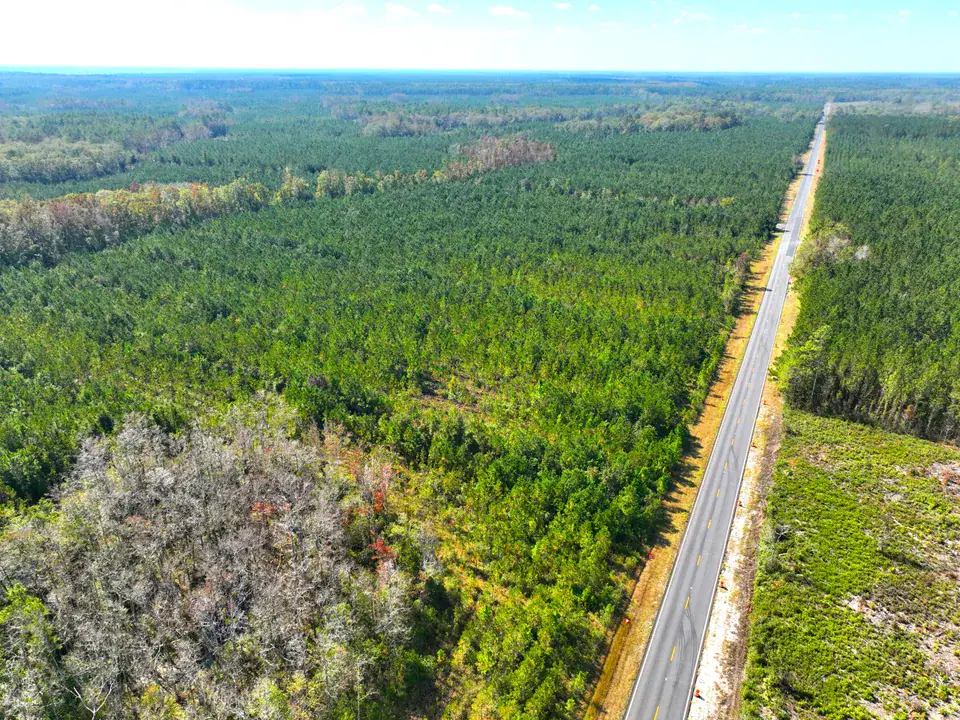
How Georgia Timberland Investing Actually Pays Off
If you’ve spent any time researching Georgia timberland investing, you’ve probably noticed that most of what’s out there reads the same way, telling you to weigh the location, the timber quality, and the market demand without ever attaching a number to any of it. It is the kind of advice that sounds reasonable and tells you nothing you can actually use. This article takes a different approach and presents real, current data on Georgia timber prices, the impact of Hurricane Helene, tax relief for storm-affected tracts, and the numbers behind timberland as an asset class.
What “Return” Actually Means for Timberland
Before buying a single acre, understand what you’re being paid for when you own timberland. Unlike a stock or a rental property, timberland generates return through three distinct mechanisms working at once, and separating them lets you evaluate a tract intelligently instead of just eyeballing the trees.
The first is income, the money you collect from selling standing timber, whether through a full harvest or a periodic thinning. The second is biological growth: a pine tree adds wood volume every year regardless of what the broader economy is doing, which is the one return driver no other asset class can claim. The third is land value appreciation, the change in what the underlying acreage itself is worth over time, independent of the timber growing on it. A tract that looks unremarkable on paper can still be a strong long-term hold if the land under it is appreciating even while the timber grows slowly.
Most of the generic “is timberland a good investment” content treats these three drivers as one blurry concept. They’re not. A buyer focused purely on near-term income wants a different tract than a buyer focused on long-term appreciation, and knowing which driver matters most to you should shape which Georgia counties and which timber stands you actually look at.
Why Georgia’s Position as the Top Forestry State Matters to Investors
Georgia isn’t just a state with trees. It’s the nation’s top timber-producing state, and it holds roughly 22 million acres of commercially available, privately owned timberland, more than any other state. This scale matters to you as a buyer: it means a deep, established network of mills, pulp and paper operations, and export infrastructure exists to buy what you grow and cut.
That’s a liquidity argument, not a bragging-rights one. A timberland investment is only as good as your ability to sell what you grow eventually, and Georgia’s position as the country’s leading forestry state means that market exists at scale, in nearly every region of the state, not just in a handful of specialty counties. When comparing Georgia to other timber-producing states, this structural advantage is worth weighing more heavily than almost anything else on a generic checklist. If you want to see what’s currently on the market, browse Georgia timberland for sale.
What Georgia Timberland Actually Pays: Stumpage Prices by Region
Here’s the number every buyer actually wants: what does Georgia timber actually sell for? UGA publishes Georgia’s regional stumpage breakdown once a year, and its most recent figures cover the third quarter of 2025. Based on the University of Georgia’s 2026 timber market outlook, citing TimberMart-South data for that quarter, South Georgia pine sawtimber averaged around $28 per ton, a roughly 5 percent increase compared to the same quarter a year earlier. Pine chip-n-saw in South Georgia rose sharply, up about 16 percent to roughly $23.50 per ton. Mixed hardwood sawtimber moved the other direction, down about 17 percent from a year ago to roughly $26 per ton.
North Georgia told a different story entirely over the same quarter. Pine sawtimber there averaged around $22 per ton, down about 11 percent year over year, and every other major product in the region declined as well. That regional split matters more than any single number, and it’s worth seeing side by side.
Reference period: third quarter 2025, the most recent regional breakdown UGA publishes (UGA CAES, citing TimberMart-South).
If you’re evaluating a specific tract, whether it sits in the South Georgia pine belt or up in North Georgia should shape your price expectations far more than any single average, because as the table shows, the two regions moved in nearly opposite directions in the same quarter.
For a county-level breakdown, the Georgia Department of Revenue publishes an official table of owner harvest timber values every year, broken out by county and product type. It’s worth pulling for the specific county you’re considering, since even the regional figures above will understate or overstate what a given tract is actually worth depending on exactly where it sits.
Prices keep moving across the wider region, too. By the second quarter of 2026, TimberMart-South’s own price bulletin reported that South-wide pine sawtimber stumpage had eased to about $23.34 per ton, a third straight quarter under $24. All five major products slipped that quarter, with pine pulpwood down to roughly $5.40 per ton. That figure is a broad U.S. South average rather than a Georgia number. Back in late 2025, North Georgia pine sawtimber had risen about 20 percent year over year, a reversal from its third-quarter decline. That kind of split shows how much regional and quarterly variation sits underneath any single average. A newer quarter’s data is likely available by the time you’re reading this, so ask your agent for current numbers on any specific tract rather than relying on the figures above.
How Hurricane Helene Reshaped the Market, and What It Means for Buyers Now
Any current conversation about Georgia timberland has to reckon with Hurricane Helene. The storm impacted roughly 8.9 million acres of Georgia forestland, according to the Georgia Forestry Commission’s own damage assessment, concentrated in some of the state’s most productive timberland in South Georgia. The same region supplies most of the state’s sawmills. According to UGA’s 2025 outlook report, the damaged pine timber from the storm was roughly equivalent to the state’s entire annual timber harvest.
That kind of disruption cuts two ways for a buyer. In the immediate aftermath, salvage timber flooded the market and pushed pulpwood prices down, since mills had more storm-damaged wood than they could absorb at normal value. But as that salvage window closes and the damaged inventory works through the system, the affected counties are left with a genuine supply gap. That’s part of why South Georgia pine sawtimber prices have been climbing even as North Georgia softened, an inventory scarcity dynamic playing out in real time.
If you’re looking at a tract in one of the counties affected by Helene, that context should shape two things: what you expect the standing timber to be worth today versus in five years, and whether the tract carries any history with the state’s timber tax relief program, which brings us to the next section.
The Georgia Timber Tax Credit: What Buyers Should Ask Sellers About
This often-overlooked aspect of Georgia timberland investing is directly relevant to storm-affected acreage. In response to Hurricane Helene, Georgia enacted a state income tax credit for timber losses through House Bill 223. According to a plain-language breakdown from University of Georgia Warnell School forestry economists, the credit is refundable and transferable, capped at up to $550 per acre of affected timber, and applies to eligible timber property across 66 disaster-declared counties.
Here’s the detail that matters most if you’re buying rather than selling: the preapproval window for this credit closed on December 31, 2025, and the Georgia Department of Revenue confirms approval letters went out no later than January 31, 2026. That means you, as a new buyer, can’t apply for this credit yourself going forward. But the credit is tied to the property’s timber loss, not necessarily the original owner, and the Department of Revenue’s own guidance is specific on one point: the credit can be sold or transferred only once, and only to a single taxpayer.
If you’re considering a storm-affected tract, ask the seller directly about the credit’s status. If the seller was approved, find out whether they’ve already sold or transferred the credit. If they haven’t, it may be a negotiating point. If they have, that value is already gone, and you shouldn’t price the tract as if any tax relief is still attached to it.
What the Data Says About Georgia Timberland Investing Returns
So does timberland actually pay off as an investment, beyond the anecdotal “5 to 8 percent” range you’ll see thrown around on other sites without a source attached? The clearest independent benchmark comes from the National Council of Real Estate Investment Fiduciaries, or NCREIF, which tracks institutional-grade timberland performance nationally through its Timberland Property Index. As of the most recently available data, NCREIF-tracked timberland delivered a national total return of 4.9 percent for the trailing year ending March 31, 2026, and the South region led every other tracked region at 6.56 percent, according to trade-press reporting on NCREIF’s release. NCREIF publishes new figures every quarter, so a more current number may already exist by the time you’re reading this.
NCREIF also breaks each quarter’s return into two pieces: an income return from timber harvesting and sales, and an appreciation return that reflects the change in the value of the land and standing timber itself. In the index’s first-quarter 2024 press release, for example, the South region returned 2.09 percent for that single quarter, and appreciation accounted for roughly 70 percent of it. That split isn’t unique to one quarter. It’s a structural feature of how timberland performs. For anyone evaluating a Georgia tract on projected timber income alone, that’s worth remembering. A meaningful share of timberland’s historical return tends to come from the ground itself rising in value, not just from what gets cut and sold off it.
None of this guarantees any specific tract will perform a certain way. Timber markets move with housing demand, mill capacity, and events like Hurricane Helene that can swing regional pricing in either direction. But it does mean the “timberland is a smart long-term investment” claim you’ll see on every competing page has real, trackable data behind it, once you know where to look. For a broader look at the asset class, see our related guide on why investing in timberland is smart.
Before You Buy: What to Check on a Georgia Timberland Tract
Once the numbers make sense for your goals, tract-level due diligence protects your return. Walk through these before making an offer.
- Get a current timber cruise or stand age. Merchantable pine can be a large share of a tract’s total value, and an outdated cruise will misrepresent what’s actually standing.
- Check the species mix against the region. Pine plantations dominate the pine belt in middle and south Georgia, while mixed hardwood stands are more common in the Piedmont and mountains, each carrying a different price and rotation profile.
- Confirm road frontage and deeded access. This affects both your ability to manage the timber and your resale value later.
- Look at water features. Creeks, ponds, and river frontage add recreational and resale value beyond the timber itself. If dual-use recreational land is part of your goal, our Georgia hunting land listings are worth a look.
- Ask whether the tract carries a conservation-use covenant. Land already enrolled in Georgia’s property tax conservation program comes with terms you inherit at closing, and those terms are worth understanding before you sign anything.
- Understand the federal tax treatment of timber income. The USDA Forest Service publishes general federal tax guidance for forest landowners covering how timber sales and casualty losses are typically treated, which is worth reviewing alongside a tax professional before you close.
Sources
- Georgia Forestry Commission, “Forests for Georgia, Georgia for Forests”
- Georgia Forestry Association, “#1 Forestry State”
- Georgia Forestry Commission, Hurricane Helene Timber Damage Assessment (2024)
- Georgia Department of Revenue, 2026 Owner Harvest Timber Values
- Georgia Department of Revenue, 2025 Timber Tax Credit
- UGA Warnell School / Center for Forest Business, 2025 Georgia Timber Tax Credit FAQ
- UGA CAES Field Report, Timber Situation and 2026 Outlook
- UGA CAES Field Report, Timber Situation and 2025 Outlook
- Southern Ag Today (UGA), “Pine Sawtimber Prices Soften as Pine Pulpwood Continues to Fall” (Jan. 2026)
- TimberMart-South, 2Q 2026 Bulletin (South-wide stumpage)
- NCREIF Timberland Property Index
- Agri Investor, “US timberland returns 4.9% in year ending Q1 2026 – NCREIF”
- NCREIF Timberland Index press release, 1Q2024
- USDA Forest Service, Tax Tips for Forest Landowners
- Additional informing sources: TimberMart-South, Georgia state stumpage prices; Wood Central, “Pine Pulpwood Stumpage Falls as Mills Pay More”; National Timber Tax.
If the numbers here make sense for what you’re trying to build, whether that’s income, appreciation, or both, the next step is walking an actual tract with someone who knows the county you’re looking at. Our Georgia land specialists work this ground every day and can tell you which stands carry real timber value and which are priced on hope. Browse Georgia timberland for sale or connect with a Mossy Oak Properties agent in Georgia when you’re ready to look closer.