
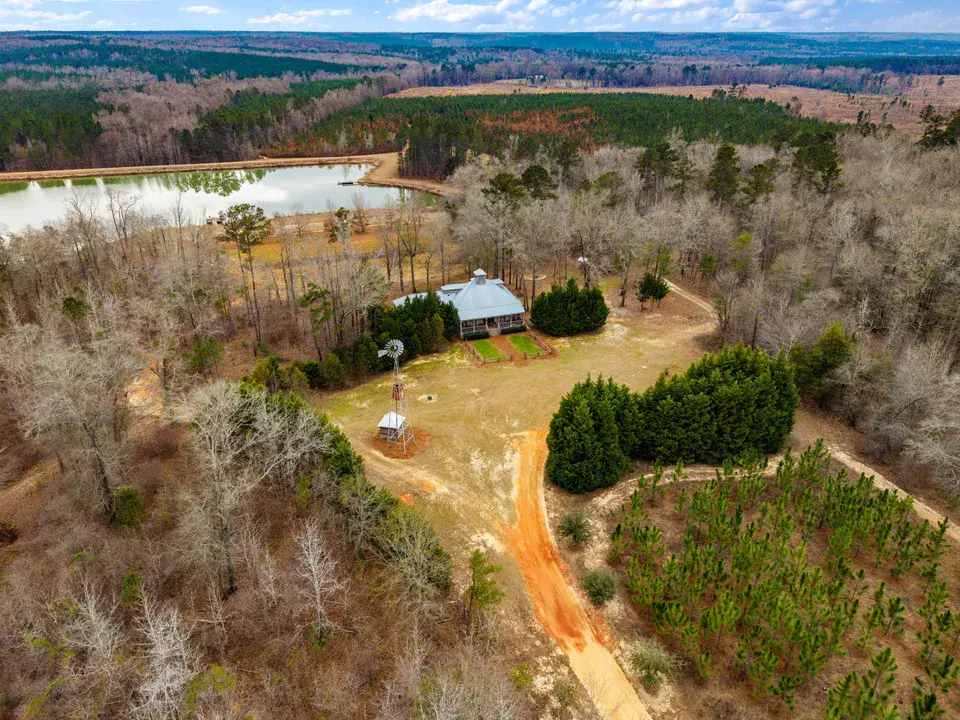
Picture two row-crop tracts in Southwest Georgia listed at the same price per acre, each with a center pivot standing in the field. One pivot runs under an active state water permit. The other runs under a permit nobody can produce, or one that was never used. If you’re buying a farm in Georgia, that permit difference can change what the ground is worth, and the asking price alone won’t tell you which tract you’re looking at.
USDA’s Land Values 2026 Summary puts a number on that difference. It lists Georgia irrigated cropland at $5,500 an acre and non-irrigated cropland at $4,350, a gap of $1,150 an acre. Water is one of several checks that set a Georgia farm’s value. The others are what each type of ground is worth, what a tax covenant commits you to, what a poultry contract actually pays, and how federal farm financing works.
Five Things to Check Before You Buy a Georgia Farm
- 2026 USDA values. $4,950 an acre for farm real estate, $5,500 for irrigated cropland, and $5,100 for pasture.
- Water permits. Permit number, status, and drought conditions for every pivot, well, and surface pump.
- Poultry records. For poultry farms, at least four years of records and written confirmation from the integrator.
- CUVA continuation. Whether you qualify to continue the seller’s CUVA covenant, and the filing deadline to do so.
- FSA limits. $600,000 direct and $2,343,000 guaranteed, with the guaranteed limit adjusted each fiscal year.
What Georgia Farmland Costs in 2026
Georgia farm real estate averaged $4,950 an acre in 2026, a 4.9 percent increase from $4,720 in 2025, according to the USDA National Agricultural Statistics Service. This figure combines land and buildings across all farm types in the state. Land type changes the number. Cropland averaged $4,670 an acre, with irrigated cropland at $5,500 and non-irrigated cropland at $4,350. Across the entire state, the USDA valued Georgia farmland and buildings at approximately $46.7 billion in 2025.
Georgia pasture averaged $5,100 an acre in 2026, exceeding the statewide cropland average of $4,670. This is in contrast to the national picture, where the NASS puts U.S. pasture at $2,000 an acre and U.S. cropland at $6,020. In Georgia, good grassland carries a premium, so budget pasture at or above the cropland average when you price a cattle farm.
Georgia vs. U.S. Farmland Value per Acre, 2025 to 2026
Georgia pasture averaged more per acre than Georgia cropland in 2026, the reverse of the national pattern, and irrigated cropland ran $1,150 above non-irrigated.
| Land type | Georgia 2025 | Georgia 2026 | Change | U.S. 2026 |
|---|---|---|---|---|
| Farm real estate (land and buildings) | $4,720 | $4,950 | 4.9% | $4,500 |
| All cropland | $4,520 | $4,670 | 3.3% | $6,020 |
| Irrigated cropland | $5,330 | $5,500 | 3.2% | Not reported |
| Non-irrigated cropland | $4,210 | $4,350 | 3.3% | Not reported |
| Pasture | $4,900 | $5,100 | 4.1% | $2,000 |
Source: USDA NASS, Land Values 2026 Summary. Values are dollars per acre. NASS reports irrigated and non-irrigated cropland values for states only.
These are statewide averages, and a single county can be significantly higher or lower than them. Our guide to what an acre costs in Georgia breaks prices down by region. Use the USDA figures as a benchmark when comparing listings, then let the soil, water, and improvements on a specific tract set your offer price.
Know Which Kind of Georgia Farm You Are Buying
Georgia agriculture is heavily focused in a few areas, and the type of farm you’re buying determines which checks matter most. The University of Georgia’s 2026 Georgia Ag Impact Report draws on UGA’s 2024 Georgia Farm Gate Value Report. It puts the state’s 2024 farm gate value at approximately $18 billion. Broilers alone accounted for $6.1 billion, or 36.1 percent of that total. Beef ranked second among individual commodities at $1.2 billion. Colquitt County led every Georgia county in total farm gate value in 2024, and UGA also lists it as the state’s top vegetable county.
Row-Crop Farms in South and Southwest Georgia
Peanuts, cotton, and corn together made up about 72 percent of the value of Georgia’s row and forage crops in 2024, according to UGA’s report. The Southwest Extension district produced 35.19 percent of the state’s total farm gate value in 2024, more than any other district. If you are shopping Southwest Georgia land, soil and irrigation water set the price, so work through the permit questions before anything else.
Cattle and Pasture Ground
Beef cows accounted for 44.1 percent of Georgia’s livestock and aquaculture value in 2024, according to the same UGA report. A pasture farm’s value lies in its grass, fencing, stock water, and working facilities. Check stock water as carefully as irrigation water. A pond or well that runs short in August limits the number of head the place can carry.
Poultry Farms
Nearly 73 percent of Georgia counties are involved in poultry and egg production, according to UGA. A poultry farm is a different purchase from open land, as much of its value comes from houses and contracts that keep birds in them. That value depends on the grower contract, the integrator’s approval, and the farm’s flock records.
Check the Water Before You Check Anything Else
Georgia regulates large farm water withdrawals through state permits, and each permit’s status can change a tract’s value. Settle the water questions before you negotiate price.
When a Georgia Farm Needs a Water Withdrawal Permit
The Georgia Environmental Protection Division requires an agricultural water withdrawal permit for anyone withdrawing more than 100,000 gallons a day from surface water or groundwater. EPD says wells with casing wider than four inches that can produce 100,000 gallons a day, or more than 69 gallons a minute, generally need a permit. Surface water systems pumping more than 100,000 gallons a day on a monthly average also need one.
Why Southwest Georgia Permits Carry Extra Weight
In 2012, EPD suspended consideration of new agricultural withdrawal permits from surface water and the Floridan aquifer in parts of the Lower Flint and Chattahoochee River Basins. The agency reviews this suspension every year. EPD’s December 2025 evaluation recommends keeping the suspension on surface water withdrawals in place, except in the Suwannee and Ochlockonee portions of the suspension area.
Groundwater has opened up, with conditions attached. Since April 1, 2025, EPD has accepted applications for new Floridan aquifer permits with drought restrictions, and it had received 18 by the time of that memo. An established permit without drought restrictions is a different asset from a new permit that can be curtailed in a dry year. In the suspension area, permits with drought restrictions or volume limits also require an EPD-approved telemetry meter on every withdrawal.
The same memo reports that EPD has set up a Compliance Unit for agricultural water withdrawals. It also says compliance pathways will address unpermitted acres or sources. EPD offers permits without drought restrictions for acres and sources irrigated before the 1999 or 2012 suspension. The application requires documentation of that earlier use, so the seller’s irrigation records matter. If a seller is running a pivot with no permit, settle how that will be resolved before closing.
Questions to Ask About Every Pivot and Well
Get these answers in writing for each withdrawal point on the farm.
- What is the permit number? Match each permit to a specific pump, well, or surface intake on the ground.
- Is the permit active, inactive, or unused? Under Georgia’s farm groundwater statute, O.C.G.A. § 12-5-105, and its surface water statute, O.C.G.A. § 12-5-31, an unused permit expires after two years unless reclassified as active or inactive. Unused permits cannot be transferred to later land owners.
- Does the permit carry drought restrictions or volume limits? This question matters most inside the Southwest Georgia suspension area.
- Is the meter installed and approved? In the suspension area, EPD says you may not begin water use until the meter is approved.
- What paperwork transfers the permit to you? Under both statutes, the permit holder may apply to transfer the permit to a later owner of the land, and EPD must receive written notice. Water use under the transferred permit may begin on the effective date stated on the revised permit. EPD publishes an Application to Transfer or Modify an Agricultural Water Withdrawal Permit and a separate application for withdrawals affected by the 2012 suspension area. Both forms ask for documentation of current property ownership, so build this step into your closing timeline.
If the Farm Has Poultry Houses, Underwrite the Contract
A poultry farm sells as land, houses, equipment, and the grower contract that puts birds in those houses. Alabama Extension’s guide to purchasing an existing broiler farm outlines what a buyer should check, and its advice applies across the state line. Its author, Dennis Brothers, is an Associate Extension Professor in Agricultural Economics and Rural Sociology at Auburn University. For Georgia, UGA Extension makes a related point in its guide for prospective contract hatching egg producers, published with full review on October 15, 2024. The guide covers breeder farms, which supply hatching eggs to integrators. It advises buyers of an existing farm to ask the integrator what improvements it would require to keep contracting with the operation. It also warns that poultry cash flow may not cover non-poultry assets like the house, barns, and trucks.
On income, lenders have often relied on three years of IRS Schedule F returns. Alabama Extension warns that three years can mislead on a broiler farm, because flock counts vary from year to year. The guide recommends analyzing at least four years of records, along with as many actual flock settlement documents as the seller can provide.
Alabama Extension advises against entering a sales agreement until the integrator confirms in writing that the farm is currently acceptable. If the farm falls short, ask the integrator for a written list of what must be done to meet its standards. Agree on any required upgrades in writing before signing, then price them into your offer or negotiate them with the seller.
For cash planning, the guide suggests that one quarter of a broiler farm’s annual variable expenses should be available as working capital. This cushion matters because broiler pay arrives at the end of each flock. It also notes that in almost all cases, the lender, grower, and integrator sign an assignment agreement. Under that agreement, the integrator sends part of the contract pay straight to the lender for the loan payment.
Utility bills reveal the condition of the houses. Alabama Extension suggests dividing annual electricity and heating fuel costs by gross revenue, with a target of 0.25 or less. Farms above 0.30 should be checked closely for inefficiencies. Water matters here too, since the guide notes that many integrators now require a farm to have two water sources.
Before making an offer on a poultry farm, ask the seller for these documents:
- At least four years of Schedule F returns and flock settlement sheets.
- The current growing contract and any bonus agreements, including whether a new owner qualifies for them.
- Written confirmation from the integrator on the farm’s acceptability and any required upgrades.
- Professional inspection reports on the houses, the backup generator, and the water supply.
Alabama Extension wrote its guide for Alabama growers, and Georgia has its own requirements. UGA Extension notes that Georgia poultry producers must dispose of dead birds by state-approved methods, and that new poultry construction must meet state and local zoning and environmental laws. Before buying, confirm the current Georgia and county requirements with your county UGA Extension office and the county planning office.
Check CUVA Status Before You Buy
Whatever kind of farm you buy, find out early whether the land is enrolled in Georgia’s Conservation Use Valuation Assessment, known as CUVA. The Georgia Department of Revenue’s conservation use guidance explains that enrolled property is assessed at 40 percent of its current use value, instead of 40 percent of fair market value. In return, the owner keeps the land in a qualifying use for ten years. An owner who breaches the covenant generally pays back twice the tax savings received up to the point of the breach.
A buyer can keep an existing covenant alive. Under O.C.G.A. § 48-5-7.4, a buyer who qualifies to enter an original covenant may continue the seller’s covenant for the rest of its term, and no breach occurs. The statute also requires the application to continue it by the last day for filing tax returns in the year after the ownership change. Put that deadline on your calendar before you close.
The statute also limits who can hold a covenant. Eligible owners are natural or naturalized citizens, certain estates and trusts, qualifying family-owned farm entities, and certain nonprofit organizations and clubs. If buying through an LLC with unrelated partners or outside investors, confirm with the county board of tax assessors that your entity can continue the covenant.
Three more provisions in the statute affect buyers. The program currently caps any one person’s interest at 2,000 acres, and the statute says leasing hunting rights does not count as operating another business on the land. Owners of tracts under ten acres must give the tax assessor extra records proving bona fide use. Proof of a Schedule F filing for the property is one way to meet that rule. On November 3, 2026, Georgia voters will decide a constitutional amendment to raise the cap to 4,000 acres. If it passes, the companion law will take effect on January 1, 2027.
Line Up Financing Built for Farmland
Once you know what the farm will cost to hold, line up the loan that will carry the purchase. Farm loans are underwritten differently than home mortgages, so start with a lender that regularly makes farm loans. The USDA Farm Service Agency lends directly to farmers and guarantees farm loans made by commercial lenders. FSA lists farm ownership loans of up to $600,000 as direct loans and up to $2,343,000 as guaranteed loans. Repayment terms on real estate run up to 40 years.
For beginning farmers, FSA’s down payment program requires as little as 5 percent down, and FSA can finance up to 45 percent of the purchase price or appraised value. FSA’s beginning farmer overview caps that loan at 45 percent of the lowest of the purchase price, the appraised value, or $667,000. This puts the maximum at $300,150, with a 20-year term. At the 2026 statewide average of $4,950 an acre, a farm of about 135 acres reaches that $667,000 ceiling. On guaranteed farm loans, FSA backs up to 95 percent of the lender’s potential loss. The guaranteed limit adjusts every fiscal year for inflation, so confirm the current number with your lender.
To qualify for an FSA farm ownership loan, you must be a U.S. citizen or permanent resident, show enough education, training, or experience to manage a farm, and show that you can repay. Ask a Farm Credit association or a community bank that lends on rural land whether an FSA guarantee fits your purchase.
Read the Soil Like a Tax Assessor
Before settling on a price, read the soils yourself. The soil map shapes what a Georgia farm can grow and how the state values it for CUVA. The Department of Revenue groups soils into eighteen productivity classes, A1 through A9 for cropland and pasture and W1 through W9 for timberland, with 1 as the most productive. These classes drive the current use values the state sets for conservation use property.
You can pull the same soil data yourself before visiting the farm. The USDA Natural Resources Conservation Service runs the Web Soil Survey, which has soil maps for more than 95 percent of U.S. counties. Draw the tract boundary, pull the map units, and compare them with what the seller says about yields. If the soils and yield history don’t match, ask why before making an offer.
A Due Diligence Checklist for Buying a Farm in Georgia
Run every farm you are serious about through these checks before signing a purchase agreement. When comparing real tracts, browse Georgia farms for sale with this list in hand.
Georgia Farm Due Diligence Checklist
- ☐Confirm permit numbers, status, and drought conditions for every pivot, well, and surface pump.
- ☐Confirm EPD meter approval for every withdrawal inside the Southwest Georgia suspension area.
- ☐Check CUVA covenant status, years remaining, and your eligibility to continue it.
- ☐Compare soil map units from Web Soil Survey with the seller’s yield history.
- ☐Get four or more years of records and written integrator confirmation on any poultry farm.
- ☐Confirm deeded access and road frontage on the ground and in the title work.
- ☐Get a current boundary survey, or budget for one.
- ☐Line up financing with a lender that makes farm loans.
Frequently Asked Questions
How Much Does Farmland Cost in Georgia in 2026?
Georgia farm real estate averaged $4,950 an acre in 2026, according to USDA NASS. Cropland averaged $4,670 an acre and pasture averaged $5,100. Irrigated cropland averaged $5,500 an acre, compared with $4,350 for non-irrigated cropland. These are statewide averages, and individual tracts vary with soil, water, location, and improvements.
Is Pasture Worth More Than Cropland in Georgia?
On average, yes. USDA NASS put Georgia pasture at $5,100 an acre in 2026, above the statewide cropland average of $4,670. Irrigated cropland, at $5,500 an acre, still averaged more than pasture.
Do I Need a Permit to Irrigate a Farm in Georgia?
You need a permit from the Georgia Environmental Protection Division if you withdraw more than 100,000 gallons a day from surface water or groundwater. EPD measures surface water withdrawals on a monthly average. Inside the 2012 Southwest Georgia suspension area, EPD is not issuing new surface water permits except in the area’s Suwannee and Ochlockonee portions. New Floridan aquifer permits there carry drought restrictions. This makes an existing permit’s status a key question when buying.
What Happens if You Break a CUVA Covenant in Georgia?
The owner generally pays back twice the tax savings received over the covenant up to the point of the breach, according to the Georgia Department of Revenue. The statute waives the penalty when the breach results solely from eminent domain or an owner’s death, and it reduces the penalty in some other cases. A qualified buyer can avoid a breach at sale by continuing the seller’s covenant for the rest of its term under O.C.G.A. § 48-5-7.4.
Can I Use an FSA Loan to Buy a Farm in Georgia?
Yes, if you qualify. FSA direct farm ownership loans go up to $600,000, and FSA guarantees commercial farm ownership loans up to $2,343,000, a limit it adjusts each fiscal year. Applicants must be U.S. citizens or permanent residents with enough farm experience or training and the ability to repay.
Sources
- USDA National Agricultural Statistics Service, Land Values 2026 Summary
- University of Georgia College of Agricultural and Environmental Sciences, 2026 Georgia Ag Impact Report: Insights for Legislators
- UGA Department of Agricultural and Applied Economics, 2024 Georgia Farm Gate Value Report (January 2026, AR-26-01)
- Georgia Environmental Protection Division, Agricultural Water Withdrawals
- Georgia Environmental Protection Division, Evaluation of the 2012 Suspension of Consideration of Agricultural Withdrawal Permits (December 8, 2025)
- Georgia Environmental Protection Division, EPD Announces Partial Lift of Water Permit Suspension in Southwest Georgia (January 31, 2024)
- UGA Extension, Circular 994: The Georgia Water Stewardship Act, Farm Use Water Withdrawal Permits
- O.C.G.A. § 12-5-105, 2025 Code of Georgia (Justia)
- O.C.G.A. § 12-5-31, 2025 Code of Georgia (Justia)
- Georgia EPD, Application to Transfer or Modify an Agricultural Water Withdrawal Permit
- Georgia EPD, Application to Transfer or Modify an Agricultural Withdrawal Permit in the Flint River Suspension Area
- Alabama Cooperative Extension System, New Farmer’s Guide to the Commercial Broiler Industry: Purchasing an Existing Farm (ANR-2940, October 2022)
- UGA Extension, Bulletin 1214: Guidelines for Prospective Contract Hatching Egg Producers (full review October 15, 2024)
- Georgia Department of Revenue, Conservation Use Assessment Information
- O.C.G.A. § 48-5-7.4, Code of Georgia via Justia, current through Ga. L. 2026 (SB 306)
- Georgia Secretary of State, Proposed Constitutional Amendments, General Election November 3, 2026
- Georgia Department of Revenue, 2025 Summary of Enacted Legislation (HR 32 and HB 90)
- USDA Farm Service Agency, Farm Ownership Loans
- USDA Farm Service Agency, Guaranteed Farm Loans
- USDA Farm Service Agency, Loans for Beginning Farmers and Ranchers Overview
- USDA Farm Service Agency, Handbook 1-FLP (Rev. 1) Amendment 292, maximum loan authorities
- USDA Natural Resources Conservation Service, Web Soil Survey
Every check in this guide goes faster with someone who has walked these farms. Mossy Oak Properties has 600 land specialists working in 30-plus states, and each office is independently owned and operated by people who know their local ground. If you’re ready to take the next step, connect with a Georgia land specialist who can walk a farm with you. Start with the land for sale in Georgia listings to see what’s currently on the market.