
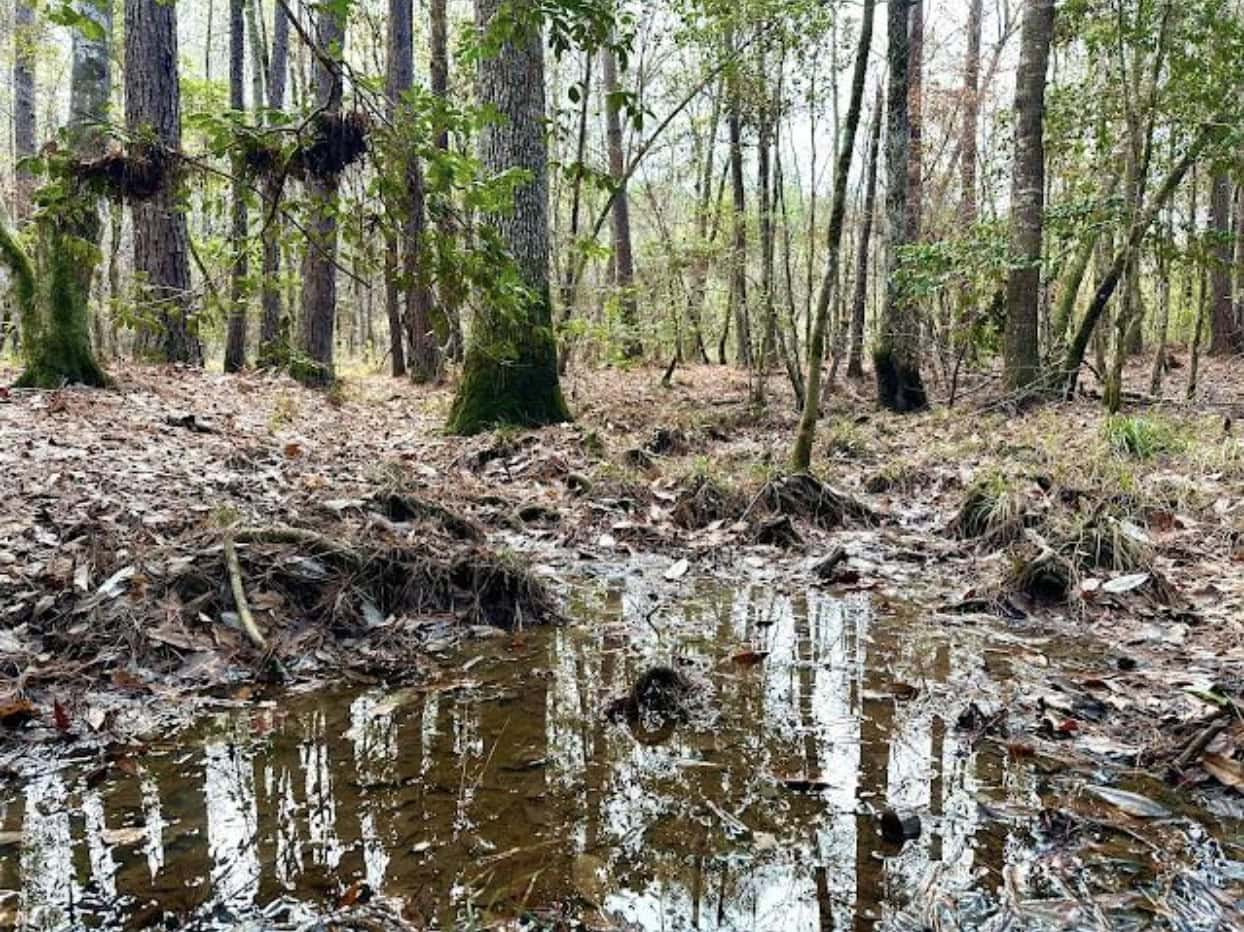
Pictured: Riparian corridor along the sandy-bottomed Double Branch Creek on a listing in Polk County, Texas. This floodplain area functions as a primary wildlife travel corridor and offers
Floodplain is one of the most misunderstood terms in rural real estate. Too often, it gets treated as a liability before it is understood and discounted before it is evaluated. In reality, many of the most productive agricultural operations, wildlife-rich hunting properties, and resilient long-term land investments across Texas are anchored by floodplain and wetlands.
Water leaves a signature on the land. Fertile bottom soils, established forage, hardwood corridors, creeks, sloughs, and seasonal wetlands are not accidental features. They are the result of a landscape shaped by water over time. When buyers move beyond a narrow development lens and evaluate floodplain through agriculture, stewardship, recreation, and investment, these acres often prove to be foundational rather than problematic.
The real question is not about the presence of floodplain. It is about how it functions within your ownership goals.
FEMA Flood Zones on Rural Land
Before you start evaluating any property with floodplain acreage, it helps to understand how FEMA classifies flood risk. These designations show up on Flood Insurance Rate Maps (FIRMs) and they affect what you pay for insurance, where you can build, and how financing works.
| FEMA Zone | Risk Level | What It Means | Flood Insurance |
| Zone A | High (1% annual chance) | 100-year floodplain. No base flood elevation published. | Required with federal mortgage |
| Zone AE | High (1% annual chance) | 100-year floodplain. Base flood elevation established. | Required with federal mortgage |
| Zone X (shaded) | Moderate (0.2% annual chance) | Between the 100-year and 500-year floodplain. | Not required |
| Zone X (unshaded) | Low | Outside the 500-year floodplain. | Not required |
The national average NFIP flood insurance premium runs around $786 to $899 per year, though individual rates vary widely under FEMA’s Risk Rating 2.0 model. You can look up any property at msc.fema.gov. Keep in mind that many Texas flood maps are outdated due to funding gaps in the five-year review cycle.
1. How Floodplain Agriculture Outperforms Upland Ground
Floodplain soils are frequently among the most fertile on a property. Periodic flooding deposits nitrogen, phosphorus, and organic matter that build the soil profile over time. European researchers have measured up to 250 tonnes of sediment per hectare per year deposited on active floodplains. This same process made the Mississippi Delta one of the most productive agricultural regions in the country.
For row crops, hay production, and improved pasture, these acres can outperform upland ground when managed properly. When you see farms for sale with bottomland acreage in Texas, that floodplain ground may be the reason the farm produces the way it does.
2. Livestock Carrying Capacity on Bottomland Pastures
Floodplain pastures tend to stay greener longer, recover faster after grazing, and provide more consistent forage through variable weather. Reliable moisture and healthier soils translate into stronger stocking rates and reduced supplemental feed costs. Natural creeks and sloughs also improve livestock water access when paired with thoughtful fencing and rotational systems.
3. Hunting and Wildlife Habitat on Floodplain Properties
Creek bottoms, hardwood corridors, and seasonal wetlands concentrate deer movement, support waterfowl, and create edge habitat that upland ground alone cannot replicate. Bottomland hardwood species like water oak, cherrybark oak, overcup oak, and pecan produce the acorns and browse that feed game year-round. There is a reason hunting leases on bottomland hardwood ground consistently command higher prices than pine timber leases.
Many of the most consistent hunting properties, and much of the recreational land for sale across Texas, rely on floodplain for bedding cover, travel corridors, and dependable water sources.
4. Recreational Uses of Floodplain Land
The uses of floodplain go well beyond row crops and deer stands. Fishing, kayaking, hiking, wildlife photography, and spending time along a shaded creek bottom all add to ownership in ways that upland tracts cannot. Land for sale that supports multiple uses tends to attract a wider buyer pool and hold value more consistently over time.
5. Floodplain Building Regulations in Texas
Floodplain and wetlands introduce rules, not roadblocks. In Texas, structures in the 100-year floodplain (Zones A and AE) must be elevated above the base flood elevation, and a Floodplain Development Permit is typically required. The floodway, which carries the deepest and fastest water, is more restricted and usually prohibits new construction unless engineering proves no adverse impact upstream.
None of this means you cannot build on a property that has floodplain. It means you need to know where the floodplain sits and where the buildable ground is before you close.
6. Conservation Easements and Wetland Reserve Programs on Floodplain Land
The Wetland Reserve Easement (WRE), administered through the NRCS Agricultural Conservation Easement Program (ACEP), is often a fit for floodplain-heavy tracts. The original Wetland Reserve Program (WRP) was folded into ACEP under the 2014 Farm Bill.
- Permanent easements receive up to 100% of the easement value and 75% to 100% of restoration costs from NRCS.
- 30-year easements receive 50% to 75% of the easement value and 50% to 75% of restoration costs.
- Landowners retain ownership and the right to undeveloped recreation like hunting and fishing; however, agricultural uses like grazing and haying are strictly prohibited unless specifically authorized by the NRCS through a Compatible Use Authorization (CUA).
When the program fits an owner’s long-term vision, it can reduce tax liability, generate direct income, and formalize habitat protection without taking the land completely out of production.
7. How Floodplain Influences Investment Value
For development-driven investors, floodplain may reduce density. For land investors focused on durability and long-term demand, floodplain can protect value by limiting overdevelopment and preserving the natural assets that drive buyer interest.
Texas rural land averaged $5,158 per acre in Q3 2025, up 5.87% year over year with an 11.24% five-year compound annual growth rate, according to the Texas Real Estate Research Center at Texas A&M. Water access and recreational value remain among the strongest pricing drivers, and floodplain land delivers both.
Floodplain agriculture, wildlife habitat, water features, and conservation income stack on top of each other in ways that pure upland tracts cannot match.

Pictured: Steve Baxter, TLA Broker/Founder, walking a property with a client to evaluate the highest and best use relative to the client’s objectives. This meadow lies within the floodplain, where considerations around agriculture are.
What Floodplain Means for Your Land Purchase
Floodplain should never be evaluated in isolation. It must be weighed against how the land will be used, managed, and stewarded over time. For some buyers, floodplain limits certain improvements. For others, it is the very reason the land produces better forage, supports stronger wildlife populations, and holds long-term value.
The most successful land purchases happen when buyers understand what floodplain means for their specific goals. Clarity replaces concern when the right conversations happen early.
If you are thinking about buying, selling, or stewarding Texas land, I would welcome the opportunity to visit with you.
At Mossy Oak Properties – Texas Land Advisors, we work with landowners and buyers to evaluate market value, identify management and income opportunities, and position land in a way that honors both conservation and return.
Call or text: Cade Baxter, Broker/Partner – 214-236-4205
Email: cbaxter@mossyoakproperties.com
Learn more: Mossy Oak Properties – Texas Land Advisors